
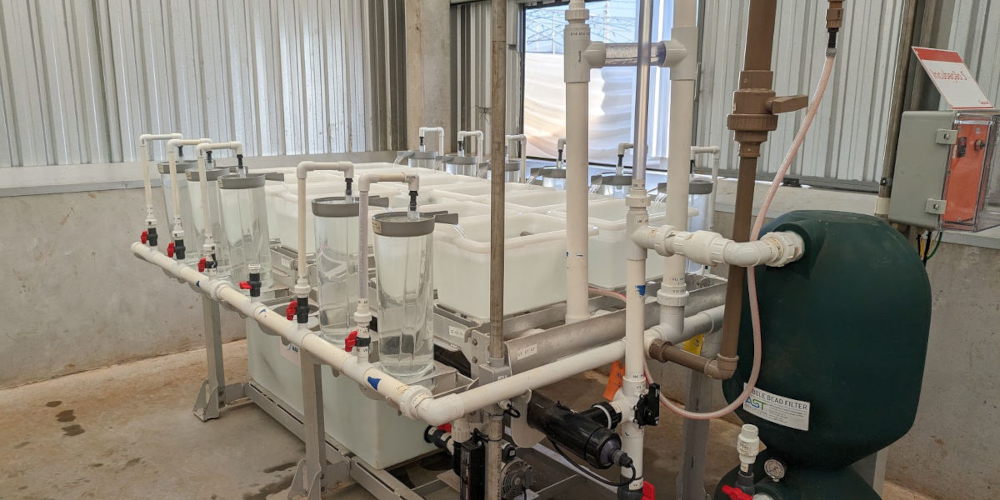
As aquaculture becomes more intensive, farms need reliable ways to protect water quality, reduce water use, and manage waste. Biological filtration is one of the core technologies that makes recirculating aquaculture systems possible.
Educational summary adapted from a peer-reviewed review by Maria Teresa Gutierrez-Wing and Ronald F. Malone, published in Aquacultural Engineering in 2006.
Jump To Section:
Key takeaways
- Biofilters are central to recirculating aquaculture systems. They help convert toxic ammonia and nitrite into less harmful nitrate, allowing water to be reused instead of constantly discharged.
- Freshwater and marine systems face different design pressures. Freshwater farms often focus on cost, energy use, and integration with ponds, while marine hatcheries and nurseries often require very high water quality and strong biosecurity.
- Biofiltration is more than nitrification. In systems with high water reuse, nitrate management and denitrification can become important, especially for sensitive life stages such as larvae, fry, and broodstock.
- Future progress depends on practical engineering. Larger, lower-energy filters, faster acclimation, and better nitrate-control strategies can help RAS technology serve more species and production models.
Why biofiltration matters in modern aquaculture
Aquaculture has grown because global demand for seafood continues to rise. At the same time, producers face limits on land, water supply, discharge permits, disease control, and environmental impact. These pressures have encouraged more intensive production systems that can grow fish or shellfish in a smaller footprint while using water more efficiently.
Recirculating aquaculture systems, often called RAS, respond to this challenge by treating and reusing culture water. Instead of relying on a constant flow of new water, RAS equipment removes solids, adds oxygen, controls carbon dioxide, and uses biological filters to transform dissolved nitrogen waste.
In simple terms, a biofilter gives beneficial microbes a place to live. Those microbes perform the unseen work that keeps ammonia and nitrite from accumulating to dangerous levels.
How a biological filter works
Fish and shellfish release ammonia through metabolism, and uneaten feed or organic waste can also increase the ammonia load. Ammonia is one of the main water-quality risks in intensive aquaculture. A biological filter supports nitrifying bacteria that convert ammonia into nitrite and then nitrate.
Plain-language process
Ammonia -> nitrite -> nitrate. This conversion is called nitrification. It does not remove nitrogen from the system, but it changes nitrogen into a form that many cultured animals can tolerate at higher concentrations.
- Fixed-film or attached-growth filters: microbes grow on media such as beads, rocks, plastic carriers, or other surfaces.
- Suspended-growth systems: microbes remain suspended in the water column, often requiring closer management but offering potential cost and production advantages in some settings.
Both approaches aim to create enough microbial activity to process the waste produced by the animals, while keeping energy use, equipment cost, and maintenance practical.
Freshwater aquaculture: cost, scale, and pond integration
For many freshwater food fish, ponds remain one of the lowest-cost production methods. That creates a challenge for fully recirculating systems: the additional equipment needed for water treatment can make RAS more expensive for commodity growout.
Even so, freshwater RAS can be valuable when the benefits outweigh the added cost. Examples include year-round temperature control, limited water availability, urban or indoor production, ornamental fish, broodstock, fingerling production, and research systems where animal health and environmental control are essential.
Where freshwater RAS has the clearest value
- Fingerlings and juveniles: smaller animals can have higher value per pound than commodity-size fish, making water-control technology easier to justify.
- Broodstock management: controlled systems help protect valuable breeding animals and support planned reproduction.
- Research and biomedical facilities: species such as zebrafish and medaka require consistent conditions and high population control.
- Water-limited regions: farms in dry or urbanizing areas may use recirculation to reduce dependence on new freshwater.
- Pond intensification: biofilters and other unit processes can help increase production in pond-based systems without fully replacing ponds.
The practical research question for freshwater aquaculture is not simply whether biofilters work. They do. The bigger question is how to make them large enough, efficient enough, and affordable enough for commercial production.
Marine aquaculture: hatcheries, nurseries, and biosecurity
Marine aquaculture has a different set of pressures. Many marine species rely on hatcheries and nurseries to supply healthy larvae, fry, or fingerlings before growout in ponds, tanks, or net pens. These early life stages are sensitive, high-value, and often more vulnerable to water-quality swings.
RAS is especially useful in marine hatchery and nursery settings because it can reduce pathogen entry, stabilize temperature, and improve control over the rearing environment. For shrimp, marine fish, and ornamentals, this control can be central to survival and reliable production.
The need for very clean water
Marine larval and nursery systems may require extremely low concentrations of ammonia and nitrite. That means a biofilter designed for a hardy growout fish may not be appropriate for a sensitive marine larval system. These applications may require larger biofilter capacity, more conservative design, and closer monitoring.
Biofilter acclimation can be harder in saltwater
New biofilters need time to develop a stable microbial community. Freshwater systems may establish effective nitrification relatively quickly, but marine systems can experience long delays, especially when nitrite conversion stalls. This makes acclimation procedures, microbial seeding, and startup protocols important areas for continued improvement.
Nitrate management and denitrification
Nitrification helps protect animals from ammonia and nitrite, but it produces nitrate. In systems that exchange little water, nitrate can accumulate over time. While nitrate is usually less immediately toxic than ammonia or nitrite, high levels can affect growth, reproduction, development, disease susceptibility, and survival in sensitive organisms.
Denitrification is the biological process that converts nitrate into nitrogen gas under low-oxygen conditions. In aquaculture, denitrification can extend water reuse, reduce nitrate accumulation, and help restore alkalinity consumed during nitrification.
This becomes particularly important for inland marine nurseries. Moving hatcheries inland can reduce exposure to storms, expensive coastal property, and some biosecurity risks, but it also makes saltwater supply and disposal more difficult. The more valuable the water is, the more important complete water treatment becomes.
Freshwater vs. marine biofilter priorities
| Design priority | Freshwater systems | Marine systems |
|---|---|---|
| Primary business driver | Cost-effective production, water conservation, temperature control, pond intensification | Hatchery reliability, nursery survival, biosecurity, high-value juveniles and ornamentals |
| Typical challenge | Competing economically with ponds or flow-through systems for commodity fish | Maintaining very low ammonia and nitrite for sensitive early life stages |
| Biofilter development need | Low-head, low-energy, scalable filters and renewed evaluation of suspended-growth options | Improved sizing for ultra-clean systems, faster acclimation, and better denitrification strategies |
| Water reuse pressure | Strong in water-limited, indoor, urban, or cold-climate applications | Strong when nurseries move inland and saltwater supply or disposal becomes expensive |
Biofilter design considerations for RAS
A biofilter should be selected as part of the whole system, not as an isolated component. Important design considerations include:
- Animal species and life stage: larvae, juveniles, broodstock, and growout animals have different tolerance limits.
- Feed rate: feed input is closely tied to ammonia production and solids loading.
- Target water quality: acceptable ammonia, nitrite, nitrate, carbon dioxide, and solids levels should be defined before sizing equipment.
- Hydraulic loading: the system must move enough water through the biofilter without excessive head loss or energy cost.
- Startup plan: new systems need an acclimation period before full animal loading.
- Backup and monitoring: oxygen, pH, alkalinity, temperature, ammonia, nitrite, and nitrate should be monitored with a clear response plan.
Research directions highlighted by the review
The review points to several areas where better biofiltration can support the next generation of aquaculture systems:
- More cost-competitive freshwater RAS: especially for growout systems that must compete with ponds.
- Large-scale, low-energy biofilters: filters that can support high water flow without high pumping costs.
- Suspended-growth biofiltration: renewed evaluation of systems that may support commodity production in certain applications.
- Pond intensification: applying RAS-style water treatment to increase pond productivity.
- Marine nursery biofilters: sizing, efficiency, and performance for low-nutrient, high-sensitivity systems.
- Marine biofilter acclimation: better methods to establish stable nitrifying communities in saltwater.
- Denitrification for inland marine systems: strategies that extend saltwater reuse while protecting sensitive animals.
Glossary
Biofilter: A treatment unit that supports beneficial microbes used to transform dissolved waste.
RAS: Recirculating aquaculture system; a production system that treats and reuses water.
Nitrification: The microbial conversion of ammonia to nitrite and nitrite to nitrate.
Denitrification: The microbial conversion of nitrate to nitrogen gas, usually under low-oxygen conditions.
TAN: Total ammonia nitrogen, a measurement that includes unionized ammonia and ionized ammonium.
Oligotrophic: Low in dissolved nutrients. In aquaculture, this often describes systems with very low target ammonia and nitrite levels.
Frequently asked questions
Is a biofilter the same thing as a mechanical filter?
No. A mechanical filter removes particles such as feces and uneaten feed. A biofilter supports microbes that process dissolved waste, especially ammonia and nitrite. Most RAS designs need both.
Does nitrification remove nitrogen from the system?
Not completely. Nitrification changes ammonia into nitrate. To remove nitrogen from the system biologically, denitrification or another removal pathway is needed.
Why can marine biofilters be difficult to start?
Marine biofilters depend on microbial communities that can function in saltwater. Establishing those communities can take time, and some systems experience persistent nitrite accumulation during startup.
Why not use RAS for every aquaculture operation?
RAS offers control and water reuse, but it also adds equipment, energy demand, technical management, and capital cost. The best system depends on species, market value, water availability, location, regulations, and production goals.
Source note
This educational page summarizes and translates key concepts from: Gutierrez-Wing, M.T. and Malone, R.F. (2006). Biological filters in aquaculture: Trends and research directions for freshwater and marine applications. Aquacultural Engineering, 34, 163-171. DOI: 10.1016/j.aquaeng.2005.08.003.
Editorial note: This page is written for general education and should be paired with current engineering guidance, species-specific water-quality targets, and local regulatory requirements before designing or operating a production system.