
Effective biofiltration depends on the development of a biofilm layer on the filter media. In bead-based biofilters, bacteria attach to the media surface and carry out the biochemical processes that are essential for purifying recycled water.
When a biofilter is first installed, it contains little to no bacteria and must be “started.” The process of establishing a bacterial population—or adjusting an existing population to changes in loading—is known as acclimation. While acclimation requires patience, it is generally straightforward: bacteria need time and a consistent food source to become established.
Starting the Biofilter
One of the simplest ways to acclimate a biofilter in a recirculating aquaculture system is to introduce a small number of hardy animals, such as fish, turtles, or mollusks, and begin feeding them. Total suspended solids are not a concern during this stage, as bead filters remove solids primarily through physical mechanisms that do not rely on an established biofilm.
Heterotrophic bacteria grow quickly and readily attach to the media, so the accumulation of biochemical oxygen demand (BOD) is typically not an issue. Nitrifying bacteria, however, reproduce much more slowly. In freshwater systems under warm conditions, nitrifying bacteria may take up to 30 days to fully establish (2–3 weeks is more common). In saltwater systems, acclimation may require 60–90 days.
Nitrogen Dynamics During Acclimation
During acclimation, total ammonia nitrogen (TAN) and nitrite concentrations follow a predictable pattern (Figure 1). Initially, TAN levels increase as ammonia is excreted by the animals. Once ammonia-oxidizing bacteria become established, TAN concentrations drop rapidly—often within 36 hours—while nitrite levels rise sharply.
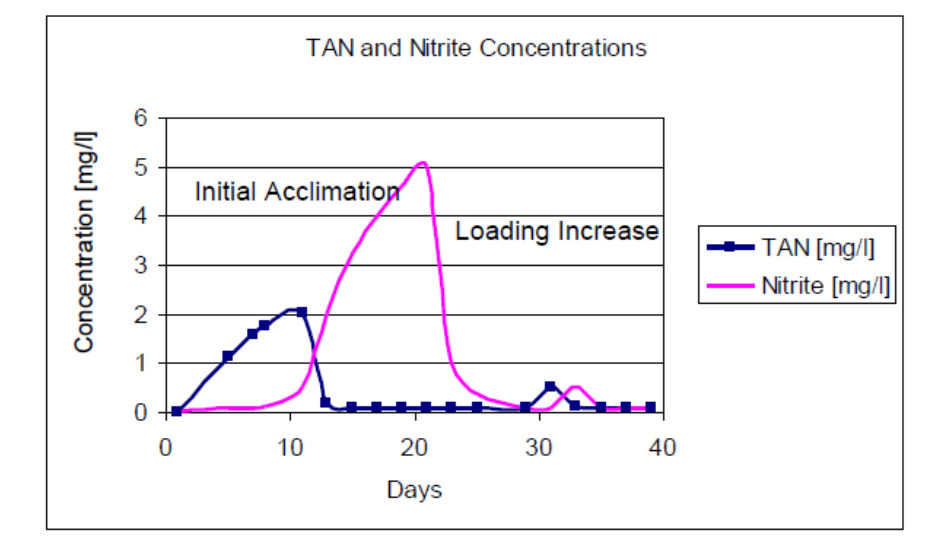
Figure 1- TAN and Nitrite concentration build-ups are normally observed during the initial acclimation of a biofilter.
Nitrite concentrations will continue to increase until nitrite-oxidizing bacteria (primarily Nitrobacter) establish sufficient populations. At that point, nitrite levels decrease dramatically. When this occurs, the biofilter is considered acclimated for light loading.
This early acclimation period is critical. During this time, bacterial populations adapt to the specific waste streams, water chemistry, and temperature conditions of the system. Once established, these microbial communities can remain stable for many years if the biofilter is operated and maintained properly.
Accelerating Acclimation
Several practices can significantly reduce acclimation time (Table 1), in some cases to as little as two weeks in warmwater systems. One limitation of acclimating a filter using animals alone is that nitrite is not available for Nitrobacter growth until ammonia-oxidizing bacteria are established. Adding a small amount of nitrite at startup can shorten acclimation by up to a week.
If acclimated media is available, acclimation can be greatly accelerated by transferring a portion of established beads into the new filter. Alternatively, backwash water or sludge from an operating biofilter can be added to the system to seed the media with beneficial bacteria.
During acclimation, backwashing should be kept to a minimum. Excessive backwashing can remove bacteria before they become firmly established. Weekly backwashing, performed only as needed to manage pressure buildup, is generally sufficient and helps maintain proper bed structure while allowing bacterial populations to mature.
Table 3.4 Things You can do to Accelerate the Initial Acclimation of a Bead Filter
| # | Procedure | How does it help? |
|---|---|---|
| 1 | Add sodium nitrite at a concentration of 1 mg-N/l on the first day. | Allows growth of Nitrobacter to start immediately. |
| 2 | Add backwash waters or beads from an established biofilter.* | Introduces species/strains of bacteria that are well suited for the bead filter's ecosystem. |
| 3 | Do not backwash bead filter. ** | Minimizes the loss of biofloc. |
| 4 | Raise the temperature of the system to 30° C. | Accelerates bacterial growth rates by increasing metabolic rates. |
| 5 | Adjust the ph to 8.0. | Accelerates bacterial growth rates by increasing ammonia (NH3) concentrations. |
| 6 | Add sodium bicarbonate to raise the alkalinity to 150 mg-CaCO3/l | Accelerates bacterial growth rates by increasing biocarbonate availability. |
*Disease may be spread with the biofilm, so make sure the source is healthy.
** Backwash only if hull pressures dictate